Part 1: Guide to jetting a Moped ! An introduction to the basics.
This blog is intended to help answer some of the questions we're most commonly asked about moped jetting....
- My moped has a brand X air filter and brand X pipe fitted, what size jet do i need?
- Will my moped go much faster with an open air filter fitted?
- Will my moped use more fuel with an open air filter
- Can I jet my bike by doing plug chops? If so how ?
First of all the boring stuff- feel free to skip straight to the 'ANSWERS TO THE QUESTIONS'
INTRODUCTION: WHAT IS JETTING ?
'Jetting' your bike means tuning or adjusting the carburettor so that it is always supplying the correct ratio (mixture) of petrol/ air at all times to the engine. Roughly speaking it's necessary for the mass of air to be approximately 13 times as much as the mass of fuel for the engine to burn all the available fuel and develop its full power potential (and run safely and reliably).
If the mixture ratio exceeds this (perhaps the jet is too small or there is an air leak) then the engine is said to be running lean, or in other words the fuel/ air ratio needs to be altered so as there is more fuel in relation to the mass of air.
The problem with a bike running lean is that not only are you down on power but more seriously the engine can run much too hot. This can cause seizures (where the piston expands from excess heat so much that it no longer will move within the cylinder) or can even melt the piston.
On a 50cc moped we find that once the mixture starts to approach 15:1 this is the point where there is a real risk of seizure and engine damage especially on long full throttle rides.
In contrast if the mixture ratio is much less than 12.5:1 the bike is said to be 'rich' whereby there is not enough air present for the fuel to be fully burnt. This could be caused by for example a restrictive or dirty air filter or a jet that is too large.
Running rich isn't as potentially catastrophic as running lean because the excess unburnt fuel acts to cool the combustion chamber, but again you won't be reaching the full power potential of the engine and wasting fuel.
On a 50cc moped we find from experience that once the mixture drops much below 12:1 it can start to cause spluttering and significant power loss.
Normally when tuning we would aim for a mixture around 12.8:1, this seems to make the most power whilst being without much risk of seizure.
One of the main problems with carb tuning is that the mixture it supplies can be affected considerably by many factors such as throttle position, temperature, engine revs and the load on the engine (how hard it is working at any instance), and as you adjust the mixture for one circumstance it affects the mixture for other circumstances and consequently *real* motorbike carb tuning is quite an art requiring considerable experience and knowledge.
This means that bike manufacturers have to tune their carbs so as the correct mixture is supplied at all times. The mixture ratio needs to always remain within an acceptable range whether the bike is ticking over at the traffic lights, cruising at half throttle, or powering full throttle up a steep hill.
The shape and position of the needle largely dictates the mixture between 1/4 and 3/4 throttle, the idle jet circuit affects the mixture at up to around 1/4 throttle and the main jet affects the mixture at all throttle positions. Some carbs also have extra jets which come into play at high revs or high load as a method of fine tuning. At full throttle however the main jet generally has the most significant effect on the mixture.
Fuel Injection
Fuel injection has considerable advantages over carbs. You can program the injectors to inject the exact amounts of fuel you want depending on throttle position, rpm, load, temperature etc. and have a far more accurate control over the 'jetting'. Some more expensive bikes are now equipped with 'closed loop' fuel injection systems.
A closed loop system incorporates a lambda sensor in the exhaust system which is able to continuously and accurately read the mixture ratio and instantly instruct the bikes computer to correct the mixture by injecting more or less fuel under any circumstance.
This effectively means the mixture is always perfect at all times whatever you do. Tuning fuel injection bikes is much more predictable and logical than carb tuning which tends to be lots of trial and error but is obviously (unfortunately) out of the realms of most diy'ers due to the specialist equipment and understanding needed and often requires expensive add-on control modules to allow modification.
It's all starting to sound a bit complicated !
Actually, no. Mopeds have one significant advantage which makes moped carb tuning very accessible for the home tuner.
Because 50cc mopeds are relatively low power they tend to spend most of their life with the throttle mashed all the way open. This is especially true of the mopeds owned by the sort of person who is going to tune it ! Also because of the way the variator works we have the bonus that the engine is spending most of it's time at a fixed rpm.
This means that all we really care about when jetting a moped at a basic tuning level is making sure the mixture is correct whilst at full throttle, full load, fixed rpm and we don't much care about anything else. The mixture under these conditions can essentially be entirely controlled by the main jet size. Happy days !
For the purpose of the rest of this article we'll therefore only be considering full throttle/ full load when we talk about jetting or mixture ratio
ANSWERS TO THE QUESTIONS !!
- My moped has a brand X air filter and brand X pipe fitted, what size jet do i need?
For now we'll just consider mopeds up to the level of tune of sports 70cc with sports pipe fitted. Whilst there is truth that all tuned mopeds should be custom jetted individually, at this fairly mild level of tune you can jet predictably without using trial and error or any other method.
The basic rules are that if you've fitted a sport pipe the jetting should be increased by 10%, and the only other thing that substantially effects jetting at this level is fitting an aftermarket filter. If you go from 50cc standard cylinder to 70cc sports cylinder you sometimes need to upjet very slightly by perhaps 2, but rarely enough to be of importance unless you're fitting a more highly tuned high revving kit.
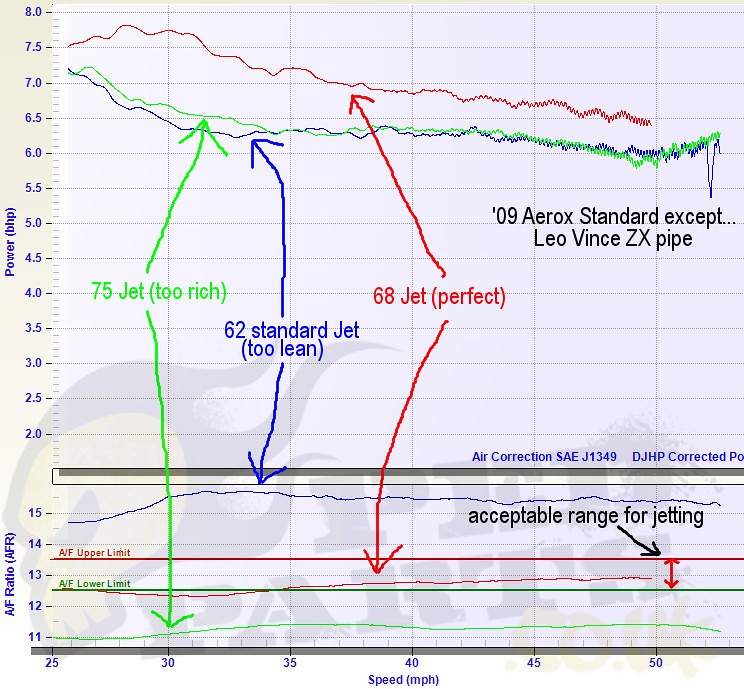
As an example we ran up an Aerox which was completely standard except there had been a Leo Vince ZX pipe fitted

As we know from earlier we want our mixture ratio to be around 12.8, and the graph shows a helpful guide 'safe zone' area as anywhere between 12.5 and 13.5
As standard an Aerox is fitted with a 62 jet, and on this moped it had not been changed after the pipe was fitted. Although a 62 jet would have run perfectly with a standard pipe we can see that with the ZX pipe fitted the bike is actually running lean at almost 16:1. Although the bike will normally seem to run ok like this, 16:1 is at the point where the bike is at real risk of seizing, especially if you ride it hard. It may work for months like that but it's definitely in the danger zone. We often see mopeds seize which haven't been rejetted after fitting a sports pipe, frequently it happens on a long (e.g. 15 miles) bike ride.
Applying our 10% increase rule if we swap the 62 jet out for a 68 we can now see the jetting is running at a much healthier mixture ratio peaking at around 12.8, and we've also gained a significant 'free' increase in power of almost 15%.
99% of the time an Aerox with a sports pipe will run perfectly like this with a 68 jet. Sometimes in cold weather or with a 70cc sports cylinder kit we would maybe have to increase to 70, but still very close.
How is the jetting affected if we now fit an aftermarket filter ?
Aftermarket air filters affect the jetting more than any other factor. If we completely remove the air filter the carb needs a 104 jet to run. We ran up some of our air filters on the Aerox with the ZX pipe to see what jet would be needed, these are the results... you can see how restrictive they are by how close they come to the maximum 104 figure where no filter is fitted

Small Polini Covered Air Filter- 88 jet, Large Polini Covered Air Filter- 96 jet

Malossi replacement for standard airbox- no change, identical jetting to standard filter
PM Tuning Filter- all PM filters are virtually straight through and ran with 102 jet with our Aerox

Polini open foam filter- 88 jet- this is quite a small filter, the large open Polini filters needed closer to 96 jet

STR8 covered filter- 96 jet- this has very high flow rate for a 'covered' filter due to its 'corrugated' filter giving a much larger surface area than you'd expect

Koso (partially) covered filter- 100 jet- like the STR8 filter this has very high flow rate for a 'covered' filter due to its corrugated filter
These figures are valid only for Yamaha Aerox with sports pipe running anything up to a sports 70cc kit as this is probably the most common setup. We'll try to build up a database to cover other bikes as time goes on.
- Will my moped go much faster with an open air filter fitted?
Not until you get to quite a high level of tune. If we run a bike up at any state of tune up to 70cc sports cylinder with sports pipe the dyno results will always be virtually identical when comparing a sports open filter to the standard airbox. It's unlikely to run any worse with an open air filter fitted but you aren't really going to see any advantage. Straight through filters come more into there own at much higher levels of tune with engines running at high revs where the more restrictive original filter becomes less able to allow through the volume of air required.Keep in mind that airboxes actually serve a useful purpose which we'll cover at a later date. Some bike manufacturers spend considerable amounts of money researching and perfecting airbox design for super and sport bikes. Some superbikes will drop 2% power if you remove the manufacturer airbox in favour of unrestricted plain filters.
- Will my moped use more fuel with an open air filter
Let's find out ! We set our Aerox up correctly jetted firstly with a standard airbox (68 jet) and then secondly with an open Polini foam filter (96 jet).
To compare fairly we need the bike to experience an identical load each time we ran it.
To do this we set the dyno to lockdown at 45mph. This means that once the dyno drum starts to reach 45mph it will automatically calculate and apply a braking force to the drum (with electromagnets) to ensure that the drum remains at 45mph and cannot exceed it no matter how hard you accelerate. This is basically the equivalent to finding a hill which is exactly the right slope that the moped remains exactly at 45mph at full throttle all the way up.We gave the moped exactly 200mls of petrol through a special tank and ran it at wide open throttle at 45mph first with the standard and then the open filter.
With the standard filter it ran for 4mins 15secs and with the open ran for 3mins 40 secs with the same amount of fuel. This works out at 71mpg for the standard filter and 61mpg for the unrestricted open air filter. In both runs the dyno showed an identical 7.0hp +/- 0.2 throughout
So, yes an open filter does use more fuel but maybe not by so much as many people believe.
- Can I jet my bike by doing plug chops/ check the colour of my spark plug? If so how ?
Well it's possible, but it can't be done in the way described on many forums and it requires considerable experience to interpret correctly.
In the shop we have lambda air/fuel meters which means we can get an accurate mixture reading whilst the bike is running at full throttle and load on the dyno but obviously you can't do this at home.
It's widely suggested that you can get an accurate idea of whether your bike main jet is running rich or lean simply by checking the colour of the plug. The theory is the plug 'colour' can give an indication as to the mixture at the time the engine was cut out. The idea is you hold your bike at full throttle for 2 or 3 minutes and then immediately kill the engine and remove the plug. Unfortunately this isn't what is meant by a 'plug chop' and it simply doesn't work.
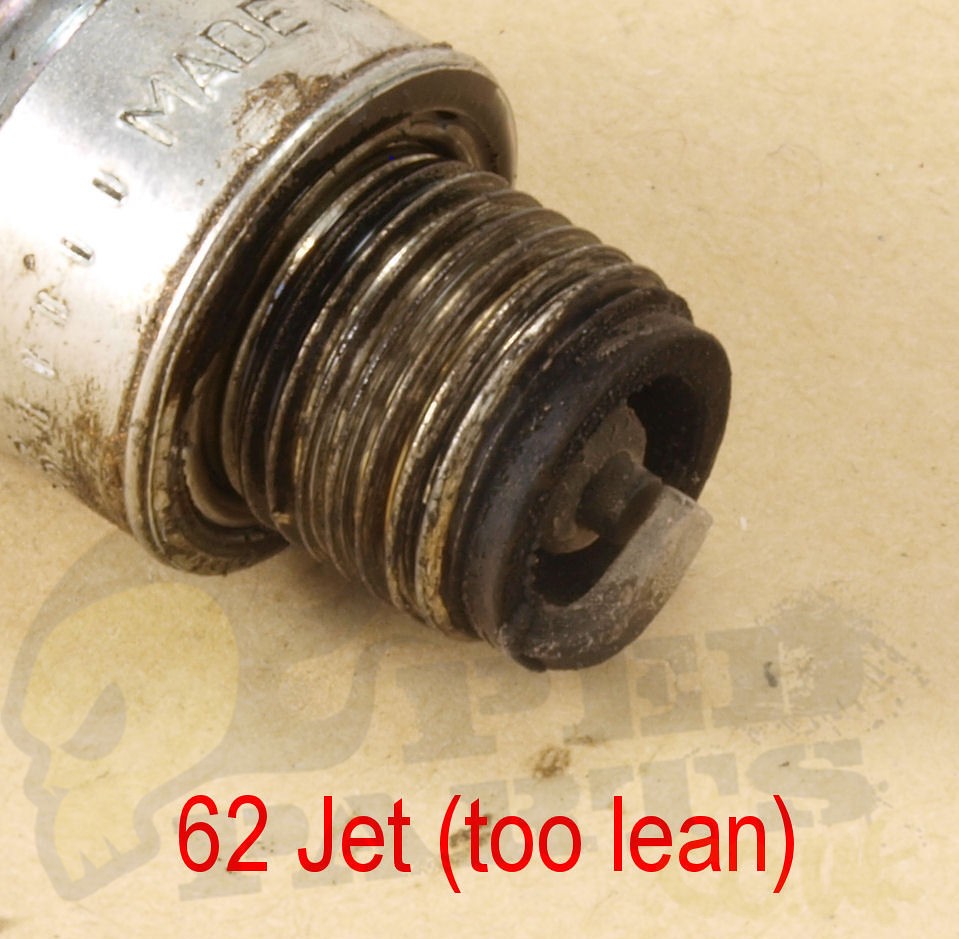
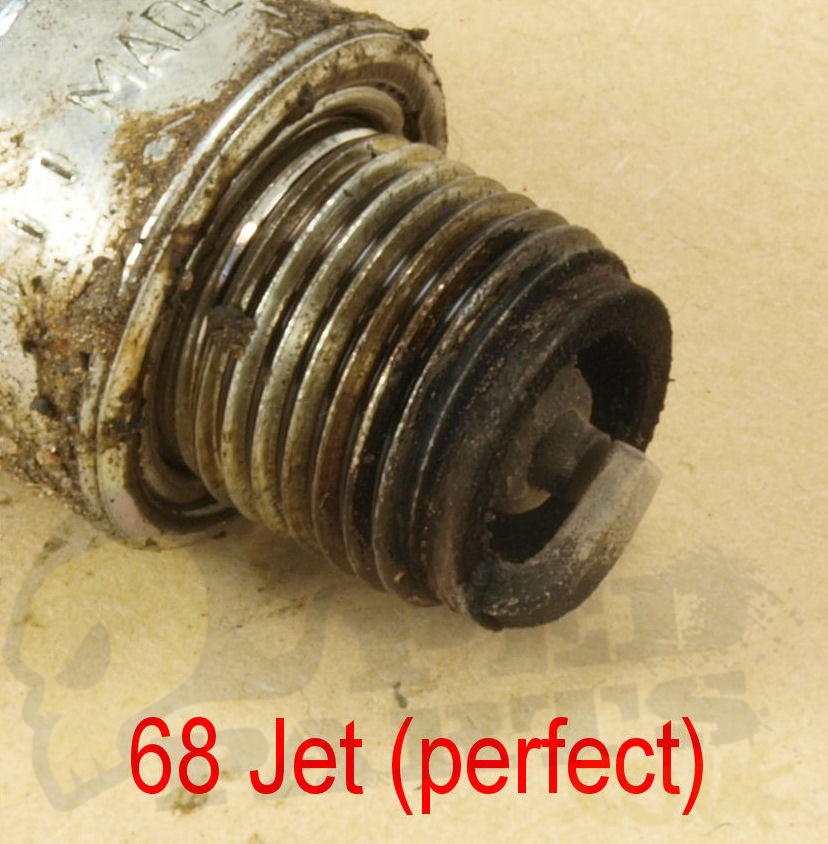
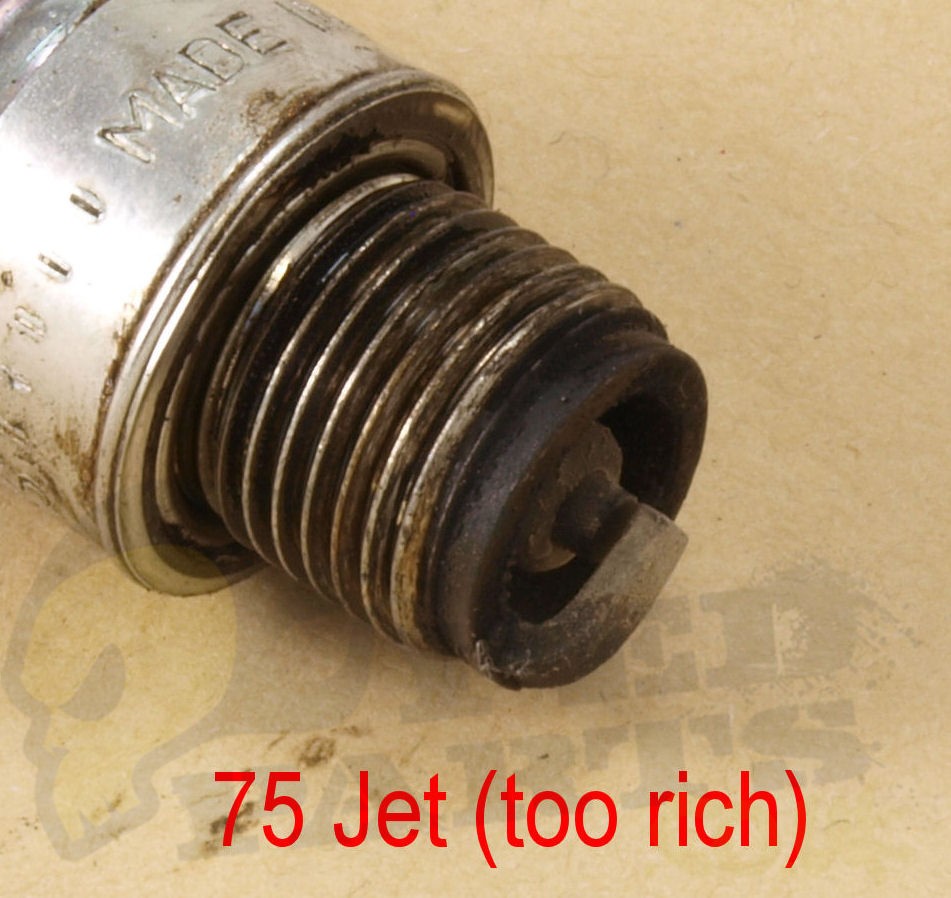
To demonstrate this we took photos of the plugs on the Yamaha Aerox used in our earlier dyno graph example.


We established earlier that with the 62 jet fitted this moped was running lean to the point at which the engine was in danger of seizing and with the 75 jet it was considerably rich. With either one of these jets the graphs show the moped was significantly down on power compared to when correctly jetted with the 68 jet.
From the pictures you can see there is virtually no discernible difference between the plug photos and there's not a chance that you'd be able to accurately jet your moped using this technique.
So how do you do a proper plug chop ? You can still get some valuable information from a plug-chop but you need to use a brand new plug everytime and be experienced in interpreting the results.
On a brand new plug the white porcelain will start to form a discolouration ring when it is first used. The colour of this band will relate to the maximum attained temperature within the combustion chamber at the time of the engine cut. This band therefore does not depict the jetting mixture but the temperature it depicts is *related* to the jetting mixture. This band will only form ONCE on a new plug, after a few more minutes use the whole of the white porcelain will be discoloured (as in the above pics) and no further useful information can be learned from it (unless there is something *seriously* wrong!) hence you need a new plug every time you do a plug chop.
This band forms at the base of the porcelain insulator deep inside the end of the plug so can be tricky to see on a moped plug.
So the procedure would be... 1) warm up bike 2) fit new plug 3) immediately run bike to full throttle under normal load and hold it there for 2 to 3 mins 4) immediately kill engine and remove plug.
The insulator should still be white at the end but will have started to discolour further inside. This colour can give an indication to the jetting but there are a few reasons (we will discuss another time) that this method is still not particularly useful on the sort of moped engines we are discussing here. In reality this method of jetting has no real usefulness for 2-stroke single small cylinder moped engines for the home mechanic.
In Haynes manuals and other online resources you'll often see different pics of different plug conditions and colours with suggested interpretations of their condition. For example a picture of a black sooty plug labelled as 'too rich'. In reality these pics are only relevant to multiple cylinder engines where the other cylinders are running correctly and there is a significant problem with one cylinder to the point where that cylinder is way down on power or not running at all and running mainly on the remaining cylinders. On a single cylinder engine the moped would likely have become unrideable or a non-starter long before it reached the condition shown in the pics. An oily plug might for example indicate badly worn rings in a specific cylinder on a multi cylinder engine but you would never see that level of deterioration in a single cylinder 4-stroke scooter because it simply wouldn't run well enough to do a plug-chop.
As a further example a black sooty plug in a moped is commonly thought to mean the jetting is too rich. But from our test above we know that it would have to be massively rich to cause this to happen- rich to the point that the bike would almost certainly not run well enough to ride... therefore a black/sooty plug instead nearly always tells us that there is an ignition problem where the bike intermittently runs rich as a secondary effect (spark poor or intermittently cutting out) but sparks correctly enough of the time to keep the engine rideable.
Unfortunately the only real way to select a main jet for your moped for the home tuner is either to use a known recommendation from a reliable source experienced enough to predict it from the *exact* bike setup you have or simply to do it by trial and error. You are looking for the largest jet which runs best in your bike. So for example if you have a 50cc Piaggio moped with standard carb and open air filter it's fairly well known the jet size could be anything up to 115...
so you would...
1) start at say 120 which you know is not going to be too small and ride the bike for a while
2) drop 5 sizes and test again... if it doesn't ride any better with the smaller size go back up a little and stay there
3) if it rides better go back to 2) and keep repeating with a slightly smaller size
remember you are looking for the largest size which runs the best with your moped - if 2 sizes run the same use the larger one (larger is safer than smaller)
also remember you are testing at full throttle !
In a future blog we'll cover the practical aspects of how you can reliably and accurately custom jet mopeds in a more sophisticated and accurate way at home for unknown setups.